Come on. Wasting 3 billion hours is not productive, how could 21 billion hours be a good thing? Well lets take the game Foldit, simply enough you fold proteins to make the shape take the lowest energy requirement possible... sounds like a job better suited to a computer, and ultimately that is the goal but it was found that people (Such as Susan, a receptionist by day and self taught microbiologist gamer by night) are better than the computers at doing this job. Oops I made a typo... I mean freaking Super Computers at doing this job! Thus at the same time a computer is training over 200,000 gamers about proteins, they are teaching a super computer how to most efficiently fold them. This process has recently led to a paper being published with 57,000 co-authors in the prestigious scientific magazine Nature.
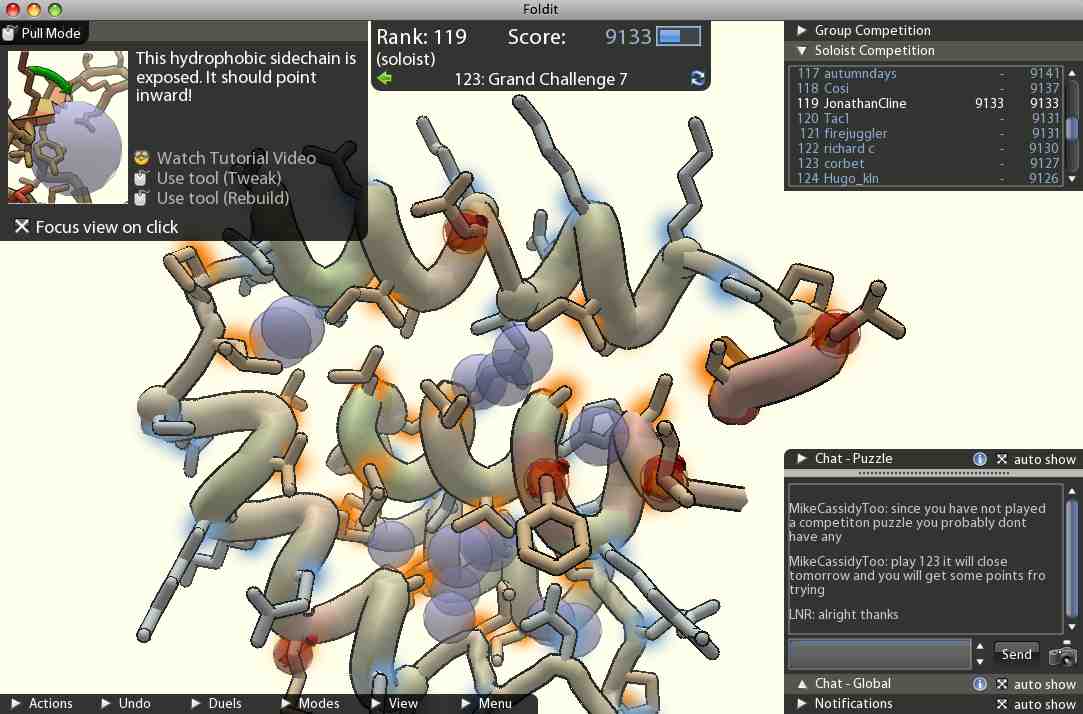 Foldit is an interesting game in the way it is essentially a 3D puzzle which can be put together in thousands of different ways, but some ways are better than others. All you do is form a preset protein into whatever shape you like, while being shown areas of greater energy use. Then the computer gives you a score depending on how energy efficient the structure is. If you do well, you rocket to the top of the leader board... until someone beats you.
 Now one thing to understand is that this is a TINY portion of 3 billion hour pool of resources that is game playing internationally, but still managed to get an amazing result. On average Foldit gets around 2,200 players per week of there 200,000 player members. So 10% in any given week will give it a go, maybe spend an hour a night collectively on the game, so lets say this is 15,400 hours a week going towards this problem. Yet it is not only the time spent playing the game which has value.
The human mind is both simple and complex, we are capable of abstract thought which makes operating within understood rules (whether based in reality or not) something our mind is well suited for. Also our subconscious is brilliant at continuing these thoughts while you are busy listening to your lecturer on a Friday afternoon, an example: While doing an essay you sit at your computer and get nowhere? If no then screw you, you win at uni and I am not playing anymore. If yes, then after taking a shower or a run, did you find the next bit of the essay seemed to flow? That is your subconscious powering through the problem while you occupied your conscious with other problems. What I am getting at is that even though you are not playing games, it is likely your subconscious is.
McGonigal created a game called 'World Without Oil' which puts your actual self (down to city and income) in a virtual world where oil is running out, posing the question what do you do? Allowing players agency and effect that is a near enough analogue to reality that the choices and responces made in the game life have a transferable affect into the real life. This makes the player think about oil usage and how they can cut down. As a novel idea it is great, but more research needs to be done to see how far this sort of game can be pushed. Maybe another way is to put real world issues in a game already proven to be popular?
World of Warcraft has over 10 million subscribers, easily the biggest MMORPG in the world and has in many cases a very fanatic audience who are engrossed in the story and playing on average 22 hours a week, essentially a part time job. Lets imagine that the designers create a game to solve a seemingly impossible Y2Kesque problem that threatens to crash the whole World of Warcraft. If the puzzle is solved the problem is solved and the player gets an epic reward.
I am going to say 50% of the users get the memo and spend only their allotted daily time of 3.14 hours playing (in other words I am going very conservative!). This would mean in one day 15,714,000 hours would go into attempting to solve that problem. To put that in perspective, that is a conservative estimation of 1793 years of human attention bombarding a problem. Just for fun, the maximum estimation (every player for twice the usual daily time = 6.28 hours, because it is such an unusual situation) would equal 62.8 million hours or 7169 years worth of time.
There are 500 million gamers world wide, playing 3 billion hours a week, that is 342.5 thousand years of attention and focus every week (48 thousand hours a day) and this number is growing. Lets take a look at what mankind has accomplished in 48 thousand years... EVERYTHING! Games are a big part of culture, with kids spending as much time playing games as they will at school by the age of 18 and collectively millions of years worth of time going into game play (5.9 million years total being put into WoW). This is an incredible resource but is difficult to harness and direct because many useful game ideas would not be appealing, so ways of implementing problems into games may be the way to solve the worlds issues. A drought in Farmville? Or cars followed by an oil crisis in WoW?
The world has never had such a large and willing collection of capable people. Yet, two questions spring up in its use:
1. How do we harness it?
2. Will 21 billion hours a week be enough to solve all of the worlds problems, as there is one thing we have been telling the critics for years in defense of games; they are only games... aren't they?
- Hugh

No comments:
Post a Comment
Note: Only a member of this blog may post a comment.